


The most popular aerial sports

Aerial (or aeronautical) sports are a safe option in the time of Covid-19. Hang gliding, paragliding, skydiving… there is something for everyone. What all these modalities have in common is that they require special skill and ability from the participants.
To find out which aerial activities are the most in demand and to understand the importance of taking out insurance for companies dedicated to these types of sports, we spoke with the Royal Spanish Aeronautical Federation (RFAE), with Alfred Sánchez, president of the Catalan Air Federation, and Íñigo Redín Micháus, president of the Navarre Federation of Aerial Sports (FNDA).
Aerial sports: Types of disciplines
According to the RFAE, the ten main disciplines are as follows: Aeromodelling, Ballooning, Hang gliding, Skydiving, Paramotoring, Paragliding, Gliding, Aerobatics, Powered flight, and Microlights.
Regarding aeromodelling, the Catalan Air Federation highlights that there are many disciplines, such as “drones, jet planes, aerobatic planes…”, to which they add other specialties like kite buggying and land sailing. And in Catalonia, “also Wind Tunnels”, adds Alfred Sánchez, president of the Federation.
Which sports are the most popular? Skydiving, paragliding, and aeromodelling: kings of the air
Regarding the best-selling aerial sports offers in Spain, the Royal Aeronautical Federation states that they are, without a doubt, skydiving and paragliding.
For its part, in the community of Navarre, the modality with the most federated members is paragliding, followed by paramotoring and aeromodelling. These are followed by powered flight and hang gliding.
As for the Catalan sky, aerial sports practice “is total”, according to the Federation. “All types of aerial sports are practiced, so there is a lot of activity… The main one, with 35% of federated members, is skydiving, 32% aeromodelling, and 17% paragliding,” points out the president. While commercially (as flights for the public as a specific and occasional activity): “skydiving, paragliding, ballooning, and Wind Tunnel.”
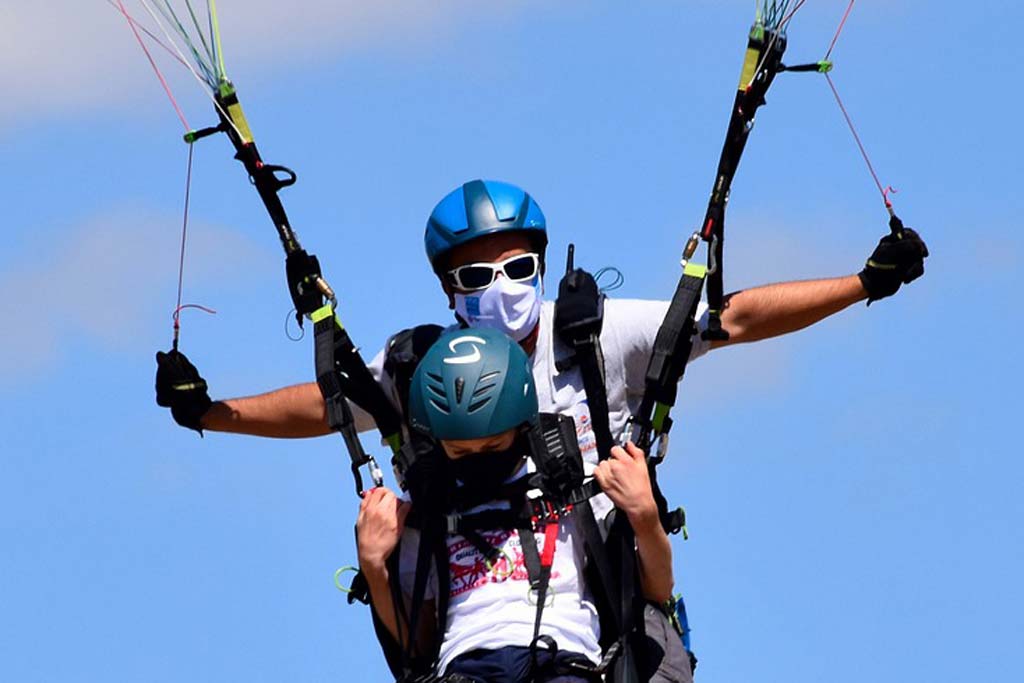
Profile of aerial sports fans
From the Royal Spanish Federation, they point out that the ages of those who practice aerial sports “consist of a wide age range, from the very young to the elderly”; those over 65 usually practice aeromodelling.
The president of the Catalan Air Federation continues to insist on the great passion for skydiving and paragliding, explaining that “there are new people who start, but then decide not to continue or practice it sporadically.”
As for Navarre, flight licenses have increased in the last year. “In our case, and largely due to the opening of a new paragliding school in Estella, which has brought more followers to this modality. In addition, paramotoring is another modality that grows a lot every year. In general, the increase in federated members is noticeable in the modalities where there is a school,” indicates Íñigo Redín Micháus, president of the FNDA.
The most extreme aerial sports modalities
“Aerobatics, skydiving, and paragliding are the 3 most eye-catching and spectacular on a visual level, although the other specialties also have a special charm,” they state at the Royal Spanish Aeronautical Federation.
The Catalan and Navarre Air Federations agree. “I would say (and it is an opinion), that the most spectacular are those related to flight. And, perhaps, those of unpowered flight. Each has its own particularities. However, there are also sports like skydiving, which is undoubtedly the one that impresses the most, and the most spectacular in terms of sensations,” adds Íñigo.
“Skydiving is the aerial sport that impresses the most and is the most spectacular in terms of sensations”
(Navarre Federation of Aerial Sports)
What is the safest time to fly?
Normally, the competition season runs from March to October, which is when there are better conditions for flying, “although you always have to keep an eye on the weather”. In fact, the season when aerial sports are practiced the least is winter, “due to the wind and inclement weather,” advises the president of the Catalan Federation.
For this reason, autumn is also a good time to conquer the airspace… Why not? Autumn is a season where it is less hot and, therefore, the weather can be milder. While the meteorology is sometimes a bit adverse, it can be a very good time to start,” they express from the FNDA.
What problems can an Active Tourism Company encounter when offering these activities?
Obviously, “the first and most important handicap that a company dedicated to aeronautical sports can encounter is that of accidents,” as well as material damage, they indicate from the National Federation.
To ensure everything runs smoothly or, rather, ‘in the air’, it is necessary for each organizing company to have qualified personnel, “athletes with experience and with the training and qualifications required to work as sports professionals,” argues Alfred Sánchez, from the Catalan Air Federation.
“The main problem that a company offering aeronautical sports can encounter is accidents. That is why taking out insurance is important”
What kind of insurance do companies offering aerial activities need?
Insurance is an essential, fundamental, and mandatory requirement, both for pilots and passengers.
“It is mandatory by Decree 56/2003 on physical-sporting activity in the natural environment,” they state at the Catalan Federation. Therefore, it is mandatory to take out sports insurance. “An accident policy and another for Civil Liability, which can cover any incident during the development of the activities,” they detail at the FNDA.
If you have a company dedicated to aerial and/or adventure sports, you can consult information about insurance at the following link: What insurance do Adventure Sports companies need?
Radical Management
If you want to stay up to date with all our recommendations and activities to do on the Costa Brava, don’t hesitate to sign up for our newsletter and follow us on Facebook and Instagram.