




Winter Ascents

Ten tips for a safe winter ascent
The mountain has everything you need this winter: fresh air, away from crowds and, above all, sport and adventure. That’s why Joaquín Álvarez, a High Mountain Guide from the Asociación Española de Guías de Montaña (AEGM), offers a series of tips for proper winter ascents, recommends interesting routes, and of course, explains how to anticipate obstacles that may arise with snow.
The best routes for mountain ascents in the heart of winter will depend on the mountain’s conditions. “Sometimes, with a lot of excess snow, it can be safer to climb a waterfall and rappel down than to summit via a normal route, and vice versa”. Everything will depend on the circumstances at any given moment.
With this aspect clear, and before delving into the quintessential top routes, it’s important to consider:
AEGM’s Ten Tips for a perfect winter mountain ascent
- Observe the weather throughout the week and for the day of the excursion. This way, you’ll get an idea of the mountain.
- Thoroughly study the route. This will allow you to assess the difficulty and challenge you can handle based on your physical condition, minimizing subjective dangers.
- Conduct a thorough analysis of the objective dangers presented by the route, and evaluate whether current conditions guarantee safety standards.
- Prepare your backpack conscientiously, separating all necessary tools into blocks: hard gear, safety equipment (beacon, shovel, probe), glasses-creams, batteries, spare clothes-gloves, food-drink, hot beverages, and communication devices.
- If you’re ski touring, bring an extra pair of climbing skins and waxes, as well as a small piece of tape in case the skin lifts.
- Walk along ridges whenever possible.
- Start early.
- Leave a notice of where you are going. Be locatable.
- Ask the refuge warden about the conditions.
- If you’re unsure, hire a guide.
Recommended routes for winter ascents
Among the mountains in Spanish territory, it’s difficult to distinguish the most recommendable ones to conquer in winter. “Among all the mountain ranges that make up the mountain systems, it’s hard to decide which mountains are the most suitable or the most beautiful for venturing into high winter mountaineering terrain”. Nevertheless, AEGM has compiled some of the most characteristic ones. They are as follows:
- Cantabrian Mountains: One of the most unique mountains in the Cantabrian Mountains, both for its alpine morphology and its proximity to urban centers, is Peña Ubiña La Grande, at 2,418 meters above sea level. It’s a classic, both in Asturias and León, as its slopes originate in both provinces. The normal routes of this mountain do not require the use of a rope, but they do require correct handling of crampons and an ice axe, as they have prolonged slopes of about 30º.
- Sierra de Gredos: The quintessential peak of the Sierra de Gredos is the distinctive Almanzor, at 2,592 meters above sea level. This magnificent granite mountain, the highest peak in Castile, presents a serious winter ascent, even by its normal route. At the end of it, the long and exposed Canales Fosques come into view. A rope for the last section might not be a bad idea…
- Sierra Nevada: The most emblematic peak of Sierra Nevada, although not the highest or the most difficult, is undoubtedly El Veleta, at 3,396 meters above sea level. It is an accessible mountain, thanks to the ski lifts of the Sierra Nevada resort, although the danger of this wind-battered range should not be overlooked, where the snow condition is usually compact, if not live ice.
- Pyrenees: The quintessential peak of the Pyrenees is Aneto, at 3,404 meters above sea level. Famous for its glacier, now diminished, it is a fantastic mountain for skiing and mountaineering, both for its ridges and for some good walls it boasts.
Regarding foreign peaks, although traveling may seem a bit distant right now, the most famous peak in Europe is Mont Blanc, at 4,810 meters above sea level. It is the roof of Europe, as well as a beautiful mountain full of scenic wonders. Despite being a commercial and relatively comfortable peak thanks to its refuges, it remains an unforgettable and highly recommended experience.
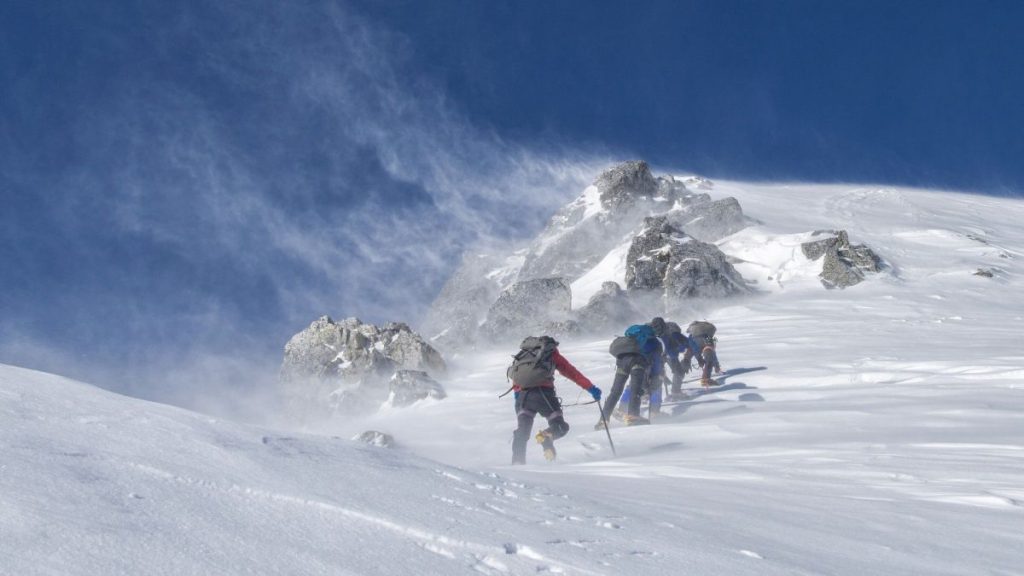
“The main distinguishing element in a winter activity is, without a doubt, snow. For a Mountain Guide, working with this element is one of the greatest privileges one can wish for, in managing safety in its full extent. What was powder snow yesterday, can be ice today; and that doesn’t happen in summer”
(Joaquín Álvarez, AEGM Guide, High Mountain and Climbing Sports Technician)
Problems that snow can cause and how to anticipate them on a winter ascent
Snow is a changing medium that requires different strategies depending on its state of transformation. And some of the most common compromising situations we may encounter are:
- You are on a flat area with hard snow and you don’t have crampons… Put them on now, so you don’t have to take them off on a slope or mid-hillside.
- If you are going to climb a peak that requires the use of a rope and you don’t have a harness yet, put it on before arriving, and in a comfortable place.
- When ski touring, the snow is hard and you’re using ski crampons, but you anticipate the slope increasing on the ascent… Put on crampons as soon as possible.
“There are a thousand scenarios, but these are the most characteristic and those that cause the most accidents”
As Chus, the manager of the company Locura de Vida, explained in her amusing article: “Mountain accidents are no joke. They can cost us our lives and endanger the lives of those who come to rescue us, so be careful, prepare, train, and use common sense”.
Essential insurance for companies and/or mountain guides organizing winter ascents
Mountain Guides are obliged to cover their Civil Liability and any Accidents that participants may suffer during activities, with respective insurance policies. “Each autonomous community regulates and legislates the conditions and limits of these insurance policies, with the minimum requirements being quite similar among them”.
Gestión Radical
If you want to stay up to date with all our recommendations and activities to do on the Costa Brava, don’t hesitate to sign up for our newsletter and follow us on Facebook and Instagram.